Two Suits.
My wife runs a business. I'm not a coder, but I see patterns. This is what happened when I built her an AI exoskeleton.
My wife paints faces.

This is about my wife.
She paints faces. Birthday parties. Weddings. The occasional Tuesday afternoon a mom books a glow-paint night because her friend's kid came home with gold filigree on her cheek and wouldn't stop talking about it.
She's been doing it for fifteen years. She remembers every kid's name. She knows the year the bride's grandparents stopped speaking to each other, and where to seat them so they don't have to. She brings the right brushes. She brings the wrong ones too, because sometimes the kid wants something nobody told her about, and she'd rather have the brush than apologize.
It's a business in the strictest sense. No staff. No office. A van full of supplies, a notebook full of bookings, and one person who is the whole company. The marketing budget is zero dollars. The marketing strategy is be very good at it, and remember the names.
She built a following in Israel that way. Three years ago we moved here and she paused — partly to learn where the post office was, partly because the kind of business that runs on a notebook reaches a point where it grows up or it doesn't, and she was ready for hers. What she came back with was bigger. Broader. Better.
Every illustration in this piece is followed by a real artifact from the platform that makes the story not a story.
The villain doesn't have a face.
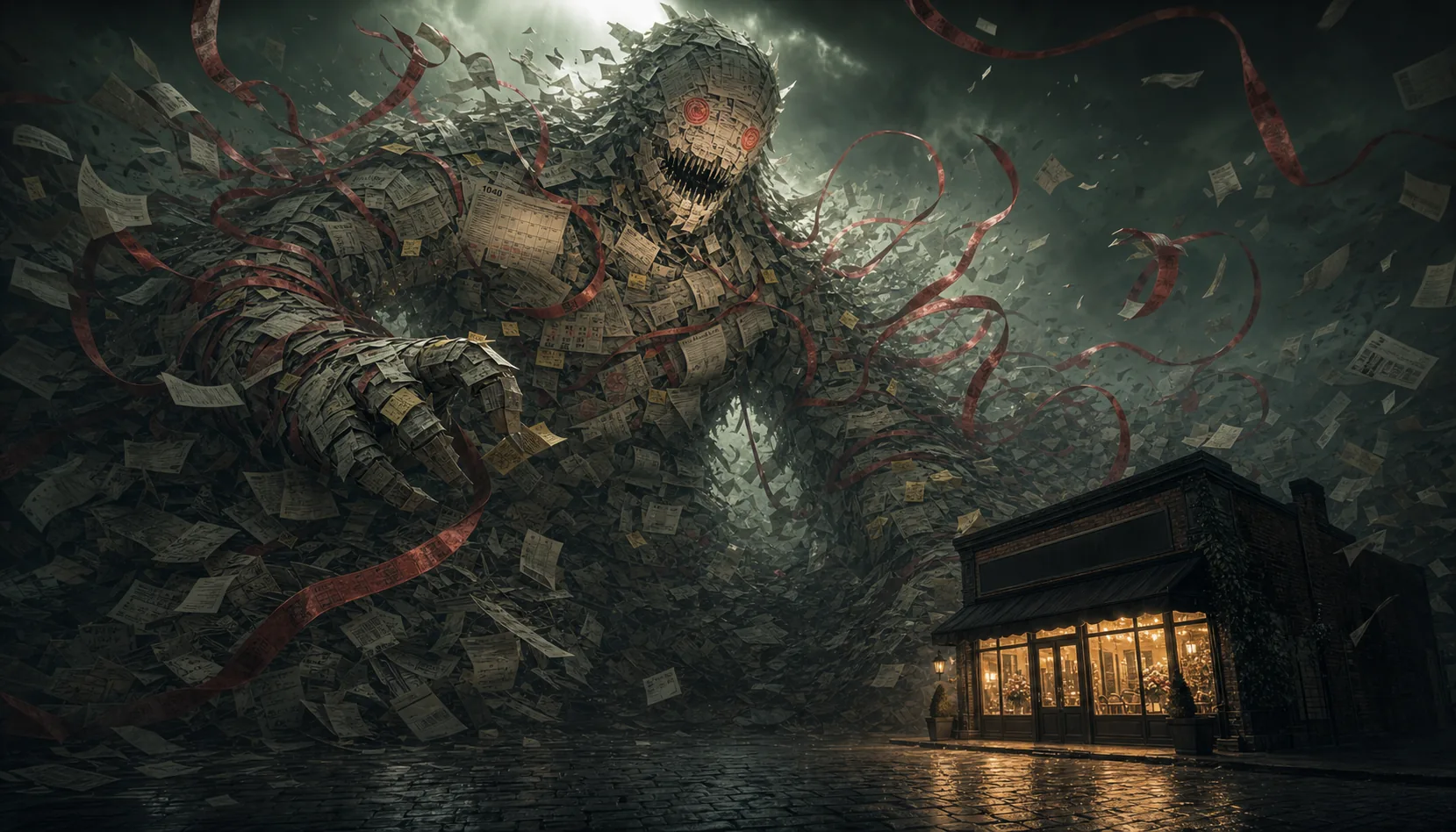
Every good story has a villain. This one's villain doesn't have a face.
It's the paperwork. The renewal notices. The booking app that worked for six months and then quietly broke on a Sunday in July. The vendor in Hialeah whose phone number got lost when she switched calendars the second time. The sticky note about the sticky note. The thing where she remembered to do the deposit invoice and forgot to mark the booking confirmed, and the bride called crying on a Wednesday because nobody had told her the deposit went through.
Most stories about businesses edit the villain out. They show you the artistry, the testimonials, the soft-focus shot of the centerpiece. They edit out the part where the owner is at the kitchen table at 11 p.m. on a Sunday with three browser tabs open, trying to figure out which calendar invite is the source of truth.
I'm leaving the villain in. Because the villain is what the story is about.
She stopped complaining around year two.

Stay married long enough and you stop hearing your partner's words. You start hearing the silences between them.
What Fefi stopped saying, mostly, was anything about the software. She'd switched calendars three times. She'd switched scheduling apps four. Each one fixed something and quietly broke something else. By the third one she stopped complaining about it. She just absorbed it. That's how I knew it was bad.
The notebook on the kitchen table grew. It had paint colors, kid names, the Hialeah vendor's number, three receipts from apps that didn't work, and a list of things to do tomorrow that she'd forget half of by morning. The lamp was on for the third night that week. She wasn't running her business anymore. She was babysitting it.
She made peace with being a little less good than she could be. Two hours a night fighting software wasn't worth it. She wanted those hours for us.
This is the quiet failure mode of good-enough software, and it's more common than people admit. The tool gets built for the average user. The user isn't the average. The user works around it. The user gets used to being slightly worse at her job than she actually is. The world calls that productivity. I call it theft.
I'd been watching it happen for about a year. Long enough to be quietly furious about it.
I'm not a coder. I see patterns.
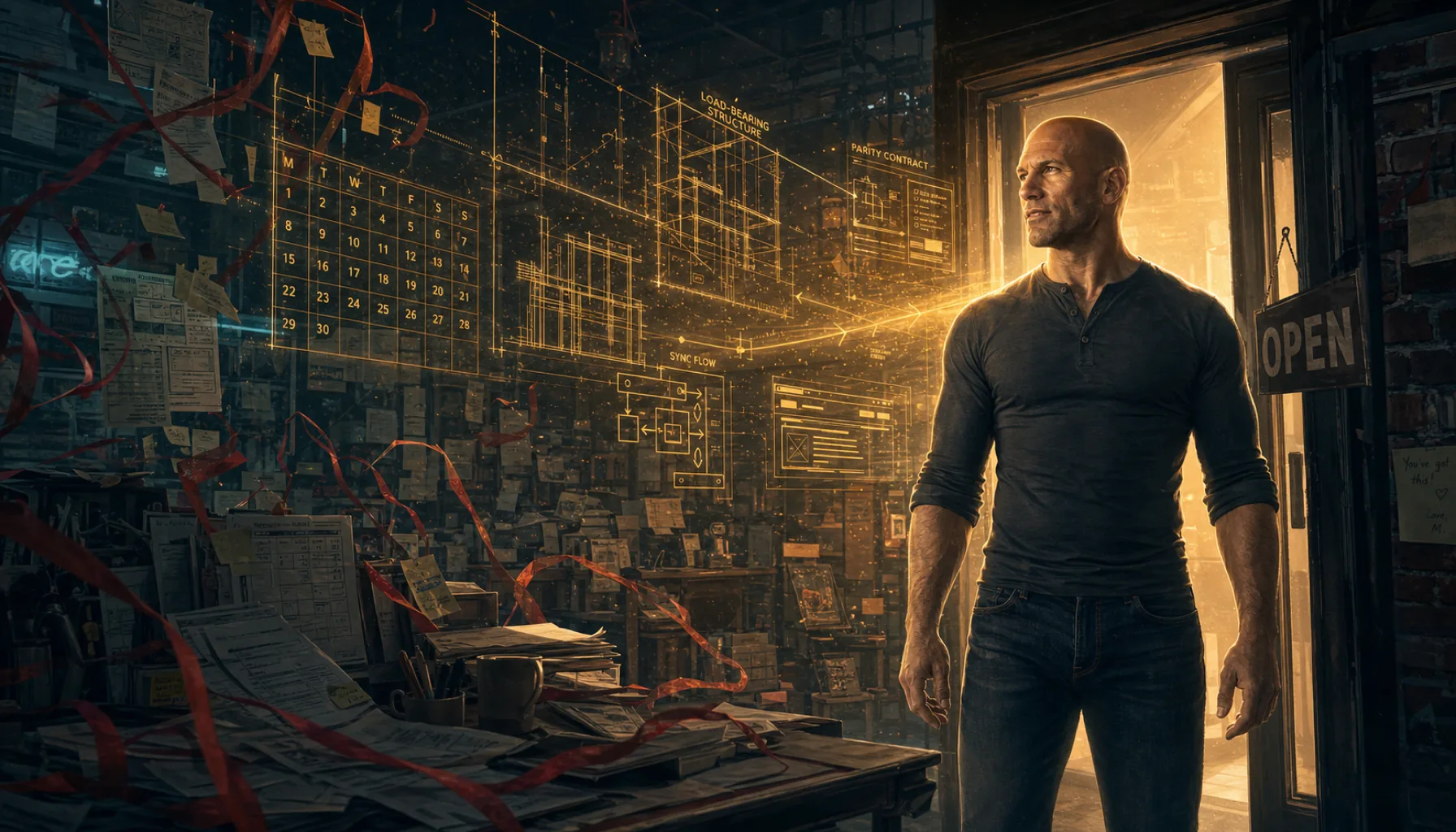
Here's what I do.
I'm not a coder. I never trained as one. I can read code well enough to argue with the people writing it, and I can write small things when I have to, but it's not the muscle I built. The muscle I built is different.
I look at a system — any system. A workflow. A queue. A business at 11 p.m. on a Sunday. And I can see the shape inside it. The patterns. The seams. The places where the structure is quietly working against the human it's supposed to serve. I've been doing it since I was nineteen, and at some point it stopped being something I do and started being the only thing I've ever been actually good at.
For most of my career, that was a gift and a curse. I could see better systems. I couldn't always ship them. Between a system I can see and a system that's running, there are usually fifteen meetings, a budget review, three roadmap fights, and a team whose calendars never line up with mine. Most architects I know have a graveyard the size of a city.
Then something changed.
Good AI is an exoskeleton.

I'd been working with AI on the gap for a long time. Long before it became a personality trait on LinkedIn.
Here's what I learned, in the boring practical way you can only learn from a few thousand attempts. Good AI, in the right hands, isn't a brain. It's an exoskeleton. It takes the thing you can already see — the system you've been carrying around in your head for a decade — and lets you go and build it. At the speed of your own thinking.
The suit does not make the man.
It makes him fly.
Most people are disappointed with AI right now because they're asking it to be the thing the suit goes around. They want it to be the brain. The judgment. The taste. The system-thinking. The architectural eye. It is not any of those things. It's a suit. It only flies if you can fly.
What changed for me wasn't that I learned to think better. I've been thinking this way since I was a teenager. What changed was that the suit finally fit.
Inside the workshop.
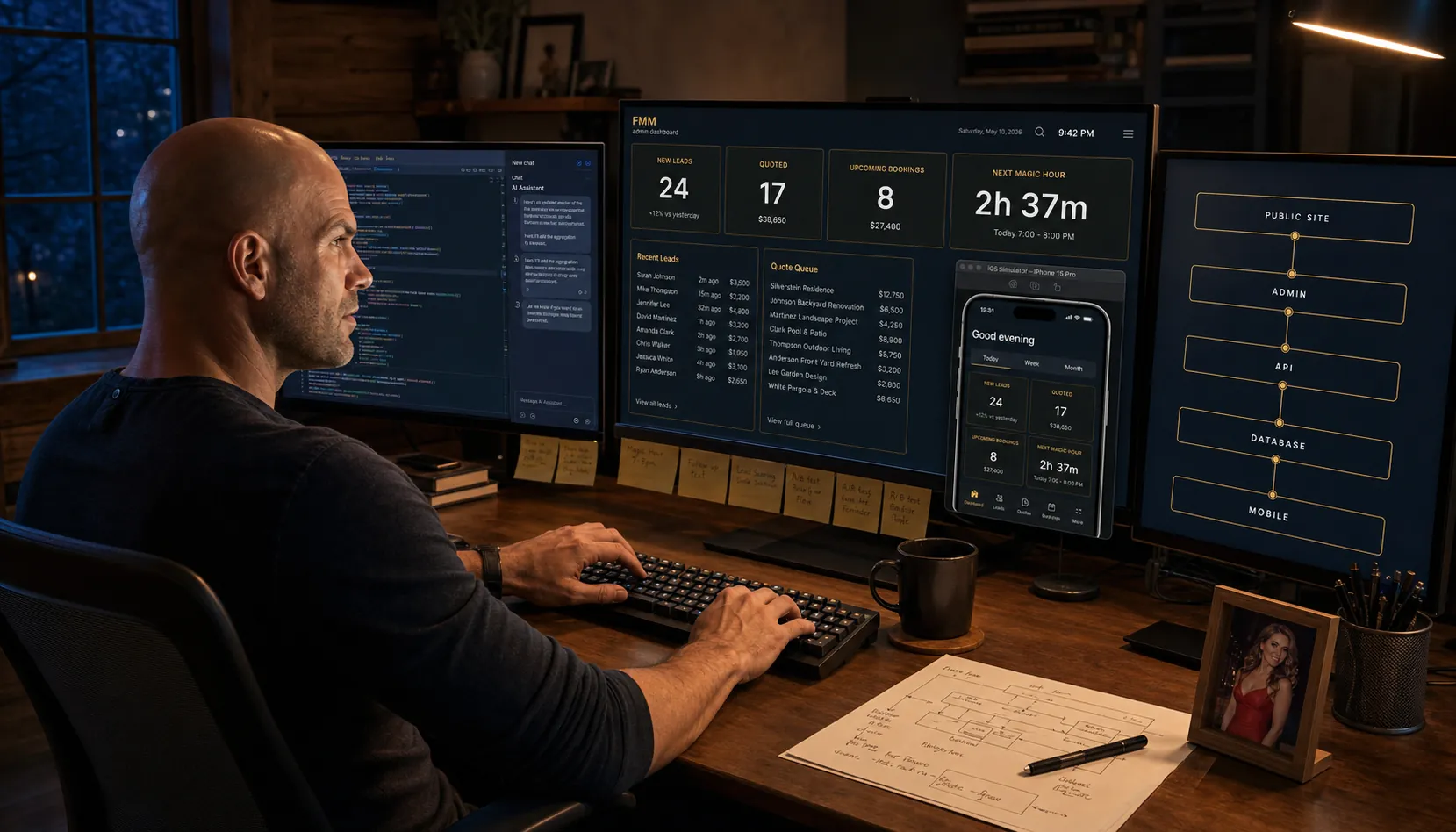
This is what the work actually looks like at 11 p.m. on a Tuesday.
Three monitors. Coffee gone cold. A picture of Fefi on the corner of the desk that I never moved because it would feel like cheating. Left screen: the live product, answering its own URL on the same machine that's building it. Middle screen: the editor and the AI typing beside me. Right screen: the plan we agreed on in plain English before any code moved.
Every five minutes, give or take, a human decision happens. It happens at the seam between the plan and the implementation. Between human decisions, a thousand keystrokes happen that I didn't have to type myself.
Inside the suit there's a team. Not a metaphor. Actual agents, each one with a defined job. One operator — me. One planner — the largest model in the stack, talks to me, draws the plan, never touches the code. Three tiers of specialists — coder, web, mobile, database, designer. They get the plan and execute. They review each other's work.
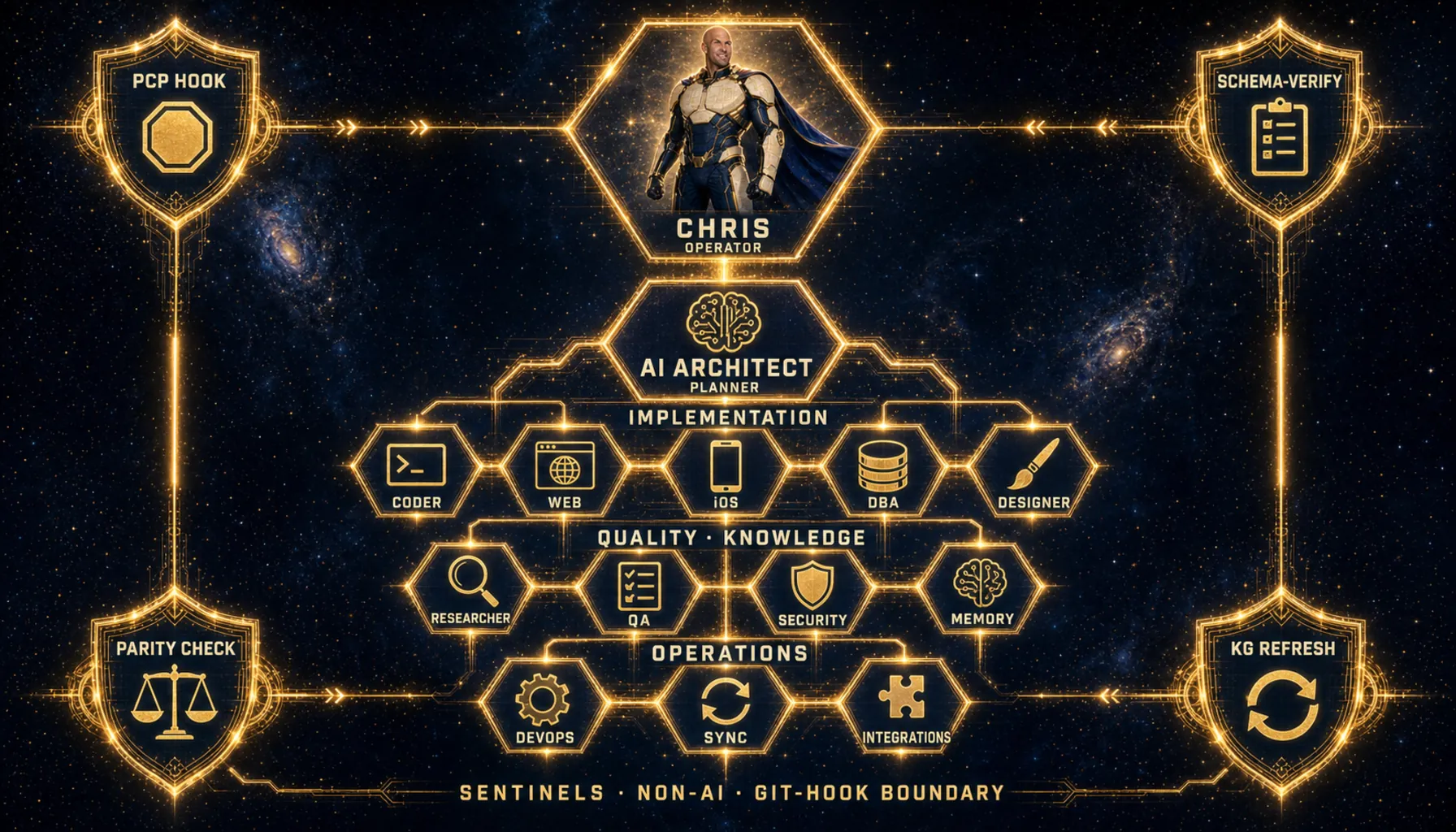
The trick that makes it work isn't the agents. The trick is that I'm the only signature on every decision. The planner can recommend. The specialists can build. Nothing ships without my plan having existed in plain English first. That's the asymmetry — between what an AI can argue and what a regex can refuse — that the next section is about.
The four guards that don't speak English.
Around the perimeter of all of this, there are four guards.
They are not AI. They are bash and python. Thirty lines each. They sit between the agents and anything destructive — a database write, a commit, an edit to a load-bearing file. They read a state file and a regex. If the state file says the model hasn't yet inspected the table it's about to modify, the call is refused before it reaches the database. If two layers of the platform stop agreeing about what a field means, the commit is refused before it lands.
An AI can argue any position eloquently.
A regex cannot be persuaded.
That asymmetry — between the model's eloquence and the guard's indifference — is the single thing that makes the whole stack shippable. I can let the model edit my codebase aggressively, because the cost of an over-eager edit is bounded by what the guards permit. The model can describe at any length why it should be allowed to drop the customers table. The guard checks a state file. The state file says no. The drop never happens.
If you build only one of these patterns into your own AI program, build the guards first. Everything else gets easier once the guards are there.
I built her a suit.
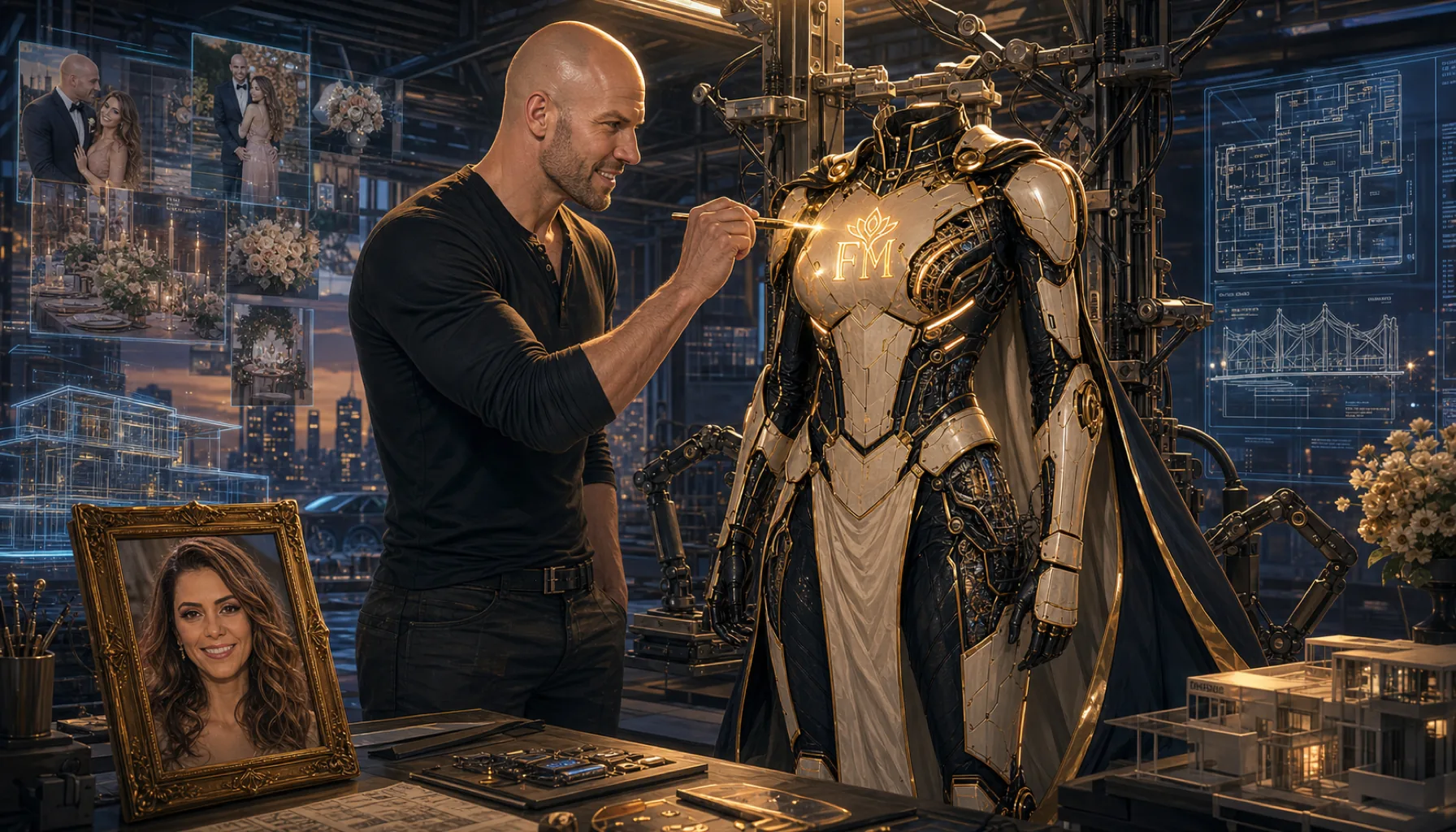
She never asked me to build it.
She never wrote a spec. I never asked her to write one. I'd been the only audience for her silences for too long. I knew what to build.
I didn't build her a CRM. I didn't build her an app. I didn't build her a SaaS subscription dressed up as a service. I built her a place to put her work down without losing it.
An exoskeleton engineered around the shape of how she actually works — that bends around her instead of asking her to bend around it. That runs from her phone because that's where her life lives — at the venue, in the supply store, in the back of the car between events. That holds her business the way she holds it, instead of forcing her to hold it differently.
This is the part I didn't see coming until I was inside it: I was building the same kind of object I'd been using all year. The AI is the suit that lets me fly. The platform is the suit that lets her fly. Same logic. Different gift. The keystone of the whole story is on the next page, but you've probably already figured it out.
The architecture, in five places at once.
The platform lives in five places at the same time.
Where her customers find her. Where she runs them. Where the truth lives. Where the truth crosses the wire. Where her life lives. Public site. Admin. Database. API. Mobile.
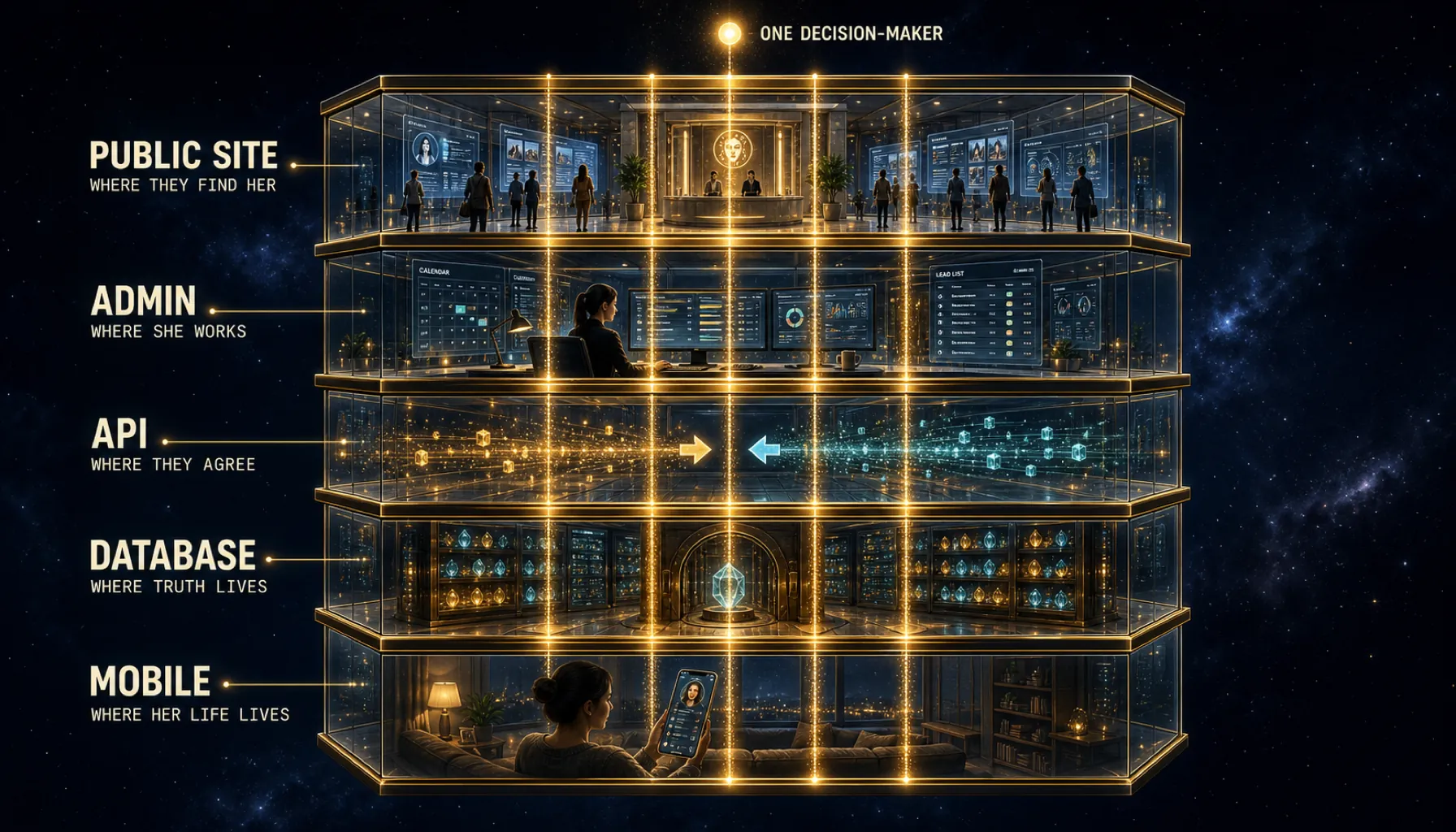
Each of those five has a different audience and a different writer. The website is what a stranger sees on a Google result. The admin is what she sees at her desk. The mobile app is what she sees in a parking lot. The database is the single record everyone agrees on. The API is the courier between them. Compress any two and you've lied to one of the audiences.
The fix is a small script that runs before every commit. It walks all five layers for every field that changed. If any two stop agreeing about what a field means, the commit doesn't happen. The model now physically cannot ship a half-finished feature. I learned that one the hard way — a contact-channel field that worked on the admin and didn't exist on her phone, which meant a wedding got the wrong number on its day-of timeline. That bug now has a hook. The hook prevents the class of bug from happening again.
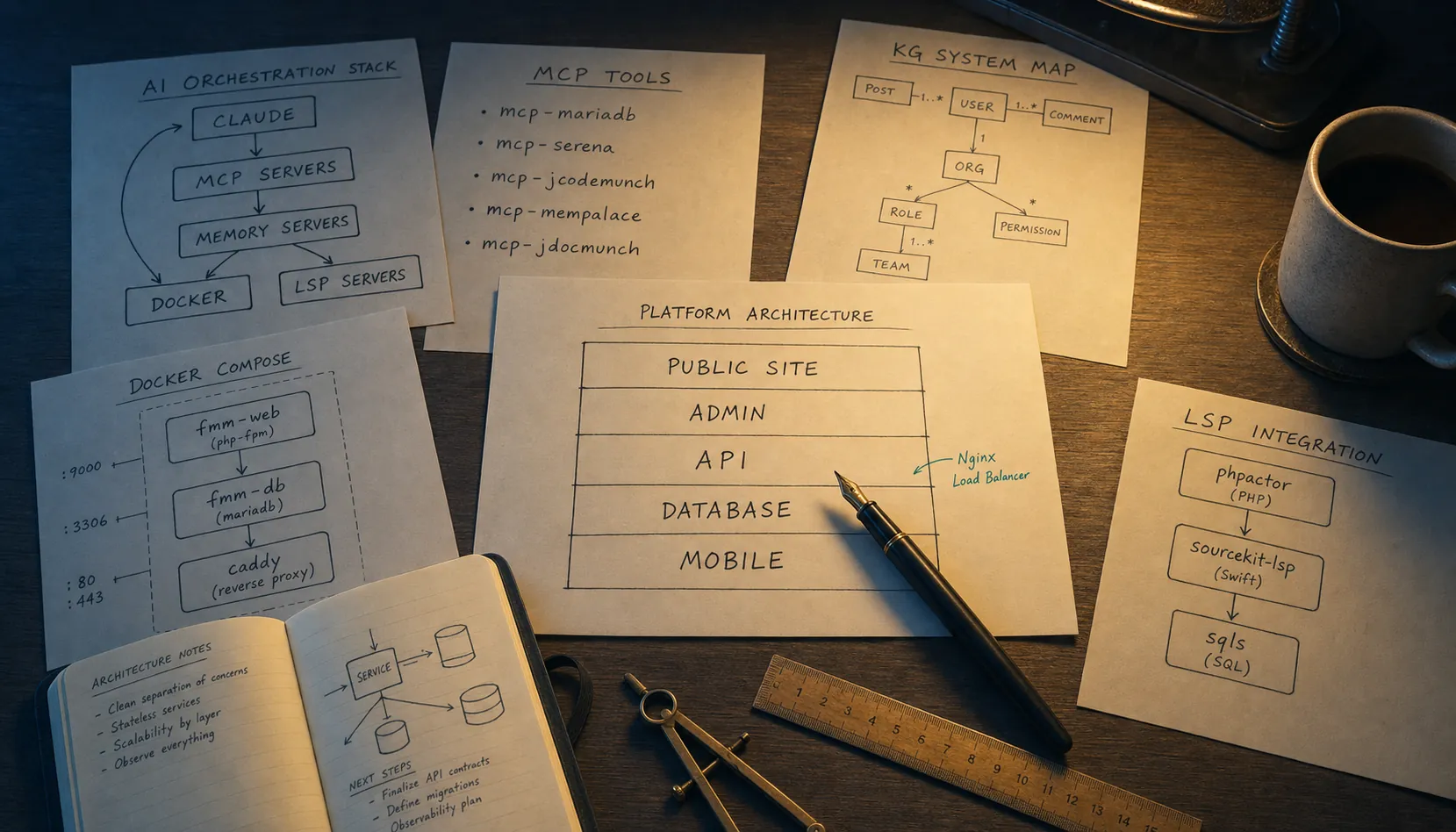
And before any of it was code, it was a sketch on paper. Paper forces you to draw the seams between layers. The editor lets you fudge them. I drew the architecture before I wrote it because architecture you drew is architecture you understand.
The same data lives on her phone as on the admin. Edits on either reflect on the other within seconds. When the WiFi at the venue cuts out — and it does — the phone keeps working. Edits queue. They drain when signal returns. The server merges them silently. She doesn't see a spinner. She never knew there was a problem.

This — the way the platform absorbs the WiFi cutting — is what the rest of the architecture is for. The orchestration. The five layers. The four guards. The same containers in production as on this desk. The fail-closed integrations. All of it exists so that on a Sunday in November, at 7:43 p.m., in a basement ballroom in Sunny Isles, when the WiFi cuts mid-event and three edits queue up in the dark, she doesn't have to know about any of it. The architecture absorbed it. The wedding kept going.
The technical detail of how each of those pieces works lives in the builder's guide. The point of this article isn't the technical detail. The point is that it works — and what it gave back.
Two suits.

Here's the part I didn't see coming until I was already inside it.
If AI is the suit that lets me fly — that takes my architectural eye and finally gives it the ability to ship — then the platform I built for Fefi is the same kind of object, pointed the other way.
The AI gave me back my throughput.
The platform gives her back her artistry.
She's not an architect. She's an artist. The platform takes the businesswoman half off her — the calendars, the invoices, the apps that broke — and hands her back the rest of the day. The day she was supposed to spend painting faces.
Two suits. Same architecture of amplification. Two people who get to spend more of the day being the part of themselves they actually like.
I started this thinking I was building her software. It turned out I was building both of us a way home.
The fight nobody sees.

Every story owes the reader a fight scene. In a real production system, the fight is mostly invisible — and that's exactly the point.
The double-booking that doesn't happen because the calendar and the API agree on time zones. The waiver that emails itself the moment a booking is confirmed, signed on a parent's phone in the school pickup line, archived securely, pulled up on the venue's iPad without anyone fumbling for a folder. The invoice that recomputes itself when she changes the package. The audit trail that just exists on every action, because that's how the platform is built — not because somebody added it in a panic.
None of those wins are visible. They look like nothing. They look like absence. The two hours she used to spend fighting bad software on a Sunday night — those don't happen anymore. That's the fight.

The villain doesn't get a death scene. It doesn't get to be defeated in a dramatic frame. It just slowly stops mattering. The Sundays come back one at a time. The kitchen table at 11 p.m. has the lamp on for a different reason now — because she's reading, or we're talking, or one of the boys can't sleep. Not because there's software to fight.
She didn't get faster. She got back the version of herself she was when nobody was making her be the businesswoman. The version that remembers the kid's favorite color and brings the right brushes. The version that gets booked again because the mother in the next school district saw the gold filigree.
The evenings.

Which is, in the end, the actual point of all of this.
I didn't build the platform because the business needed it — although it did. I built it because every hour the software was costing her was an hour we weren't going to get back. An hour the boys didn't get with their mother because their mother was at the kitchen table with three browser tabs open. An hour I didn't get with my wife because my wife was inside someone else's calendar app, losing.
The platform isn't, fundamentally, a business platform. It's a time platform. It produces hours. Some of those hours have her name on them. Some of them have mine. Some of them have the boys' names on them. The ones I care about most have our name on them.
The best kind of software, when it's built for someone you love, isn't measured in features or uptime or conversion rate.
It is measured in the evenings you get back.
That's the whole story. Everything else is the architecture under it.
There are two more pieces to this story.
This article tells you what happened and what it gave back. There's a graphic novel version that tells the same story in panels and captions — five minutes, image-first, the same arc. And there's a builder's guide that walks the architecture in detail: the four guards, the five layers, the orchestration, the deployment topology. Diagrams, cheat sheets, the exact tools I use and why I chose each.
If you want to actually build your own version of the suit, the builder's guide ends with a Claude Code skill bundle called exoskeleton. Five skills, one command. Local environment, hooks, agents, slash commands, VPS deployment — wired up and running.
She designs the days other people remember.
I am writing the floor underneath them.